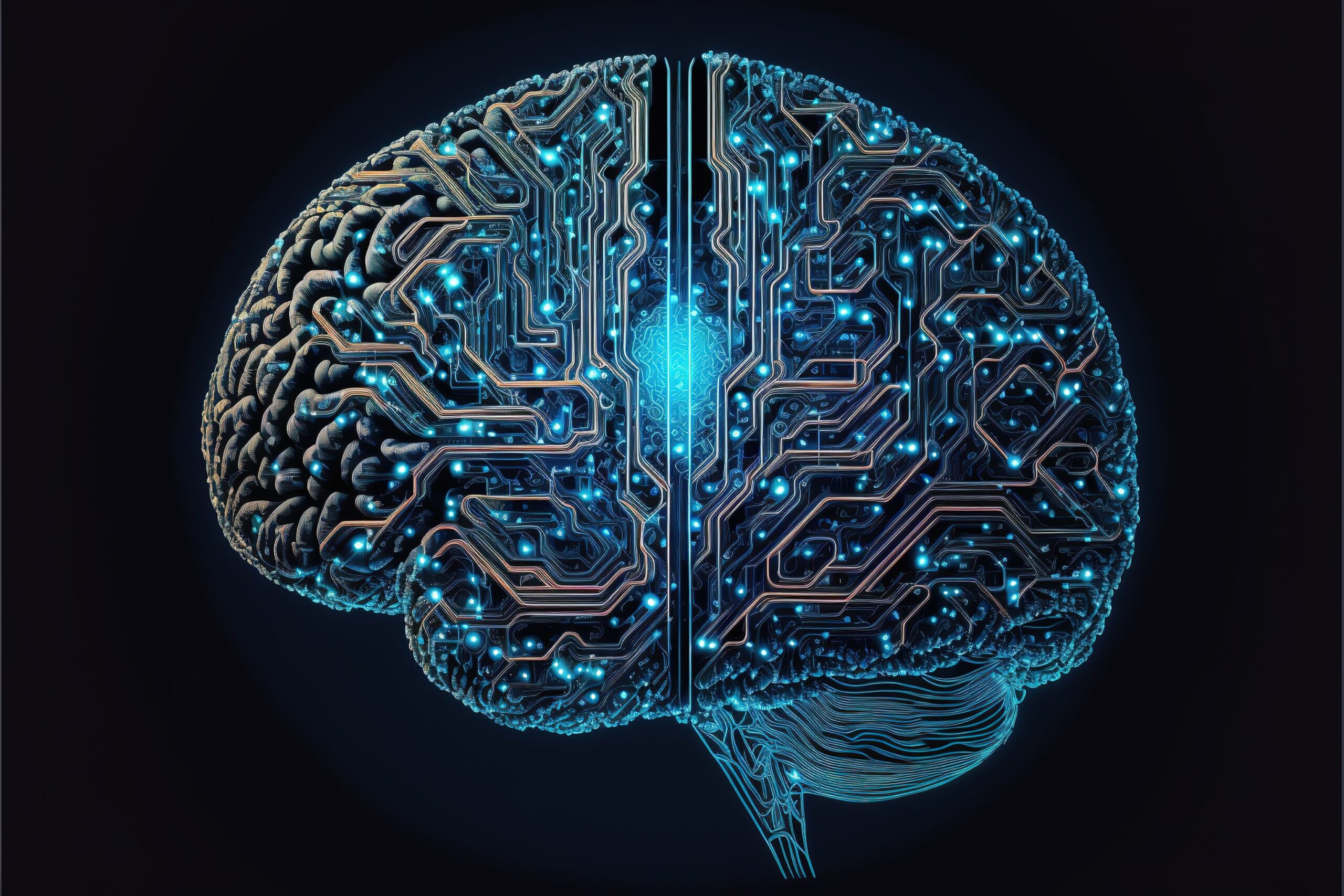
Back in 2016, Microsoſt launched an AI chatbot on Twitter in the hope that it would learn by interactng with users. Named “ Tay”, the chatbot presented as a young woman, which seems to be pretty standard – more about why this might be later. It took less than 16 hours, according to CBS News, for Tay to start postng ant-semitc tweets, and to say that all feminists should die and burn in hell.1
Microsoſt fell over itself taking Tay offline and later issued an apology, saying that a co-ordinated exploit had trained the chatbot in such inappropiate ways. Was it really so easy? And is the world now safe from naïve chatbots spreading Nazi propaganda? If only! Alex Hern, in a Guardian artcle, notes that some of the most powerful AI models have been trained on huge datasets which, although they do draw on websites like the Guardian, also use white natonalist and far-right websites and news organisatons.2
This isn’t a problem that’s going away any tme soon. You may have notced the AI overview that now appears at the top of many Google searches. David Gilbert, in a Wired artcle, writes that search result overviews about the average IQ in various African and Asian countries were apparently sometmes being drawn from a dataset published in associaton with the Pioneer Fund, a group founded by US Nazi sympathisers in the 1930s, and of course you can guess the kind of IQ being suggested by them. Not only Google but Copilot and Perplexity were also referencing this long-debunked data.
Some of the famous errors made by Google’s AI image categorisaton are almost laughable, or would be if they were not so grossly offensive and potentally dangerous. Such as the black soſtware developer who noted that he and his friends had been labelled as “gorillas” by Google Photos. A statement from Google promised a quick fix but two years later Wired magazine noted in an artcle that the issue had not been truly solved: Google had simply blocked the photos from using labels like “gorilla” or “chimp” so that when asked to search for any black person the fix forced the AI to ignore the simian labels.3 That is a band-aid, not a soluton.
In a world in which many countries are moving towards authoritarianism the technology is deliberately being used to spread disinformaton, including deepfakes, with, for example, an apparent robocall in New Hampshire mimicking Joe Biden’s voice to discourage voters from turning out to the polls4. And we can probably expect more of the sort of disinformaton that has already been affectng us on this side of the pond. Aſter the tragic knife attack in Southport on 29th July a theory spread like wildfire: a post on “X”5 – now deleted – said that the suspect was a channel migrant, giving an entrely fictonal name which acted like a dog whistle for the ant-Muslim, ant-immigrant riots that followed aſter many accounts, including AI bots, shared the lie. Elon Musk joined in with a tweet statng that civil war was now inevitable in the UK6, while the misogynist Andrew Tate, who is under house arrest in Romania and is also wanted in the UK on charges of rape and human trafficking, told the Britsh public that the aꢀacker was an “illegal migrant” and that we should “wake up”. In fact, the attacker was a Britsh citzen born in Cardiff.
And amidst all the chaos and recriminaton, somehow the media almost forgot about the three little girls who died and the ten other people, including eight children, who were injured. And as noted above, all this disinformaton was assisted by AI bot accounts, writng and sending their own tweets.
I’m as concerned as anyone about the effect of the ever-increasing numbers of AI image and writng generators, which are certainly having an effect on writers and artsts, and we should take care not to add to this effect by using such tools unaware – but every day AI becomes more ubiquitous, appearing in popular soſtware suites, such as Copilot within Microsoſt Office, and new computers and smartphones are being marketed as AI powered. In some soſtware I currently use it has been necessary for me to go through and switch it off bit by bit. If it’s available, at least let me choose to opt in rather than have to switch it off! I don’t want it because the text and/or images suggested are usually inadequate or unsuitable and I don’t see why I should spend my tme training it. Wherever you see “free” AI tools you can be very suspicious that your data will be used in training it, with your assumed permission buried deep in the tny print of the Terms and Conditons.
Things are changing so quickly that it’s hard to keep up, even between draſts of this artcle I’ve been surprised by the pace of development and disappointed to see that the UK government plans to allow AI firms to scrape content from publishers and artsts, according to a Guardian7 artcle from just a few days ago. It appears that Google warned that Britain risks being leſt behind in the race to attract investment from tech firms unless it lets them use copyrighted work.
We all know that AI stands for artficial intelligence, but is that really the case? It isn’t intelligent in any sense that includes real, valuable human aꢀributes like empathy or compassion. Right now it is just machine learning, in which the programme is given an idea of the kind of results required and access to data to allow it to use statistics to try to provide them. This isn’t true intelligence but because it’s speedy and oſten does come up with answers that are startlingly similar to human reasoning, it can be impressive. And it can’t be stressed enough that it is only ever as good as the data it is fed – which takes us back to Tay, the chatbot.
I need to get slightly technical here to explain how AI works, so bear with me. Artficial intelligence is, like virtually all computer programmes, based on algorithms, which sound complicated, especially to people who, like me, are allergic to things like algebra! But algorithms are little more than sets of instructons, together with an input: that is, the data – informaton – needed to make decisions according to the instructons. I find it useful to think of an algorithm as like a recipe, which can produce poor results if either the instructons or the input (in this case the ingredients) are not correct or are biased.
Even before AI became a household word, algorithms were in use in many sectors, including government decision making. In Sweden such a system, designed to award benefits to unemployed people, was found to be making incorrect decisions in up to 15% of cases, affectng thousands of people by stopping their benefits.8 And in Spain another algorithm for processing electricity subsidies was found to have discarded applicatons from poor households.9 Algorithmic school league tables in the UK tend to grade schools as “good” when located in a privileged area, far less so where children living in poverty oſten go to school hungry and ill-clad and where staff need to spend part of their tme providing food and clothing, rather than teaching. There are also reports that some medical algorithms have concluded that people who have been sexually abused in the past are more likely to become addicted to, for example, opioids, and who have thus, in a stunning demonstraton of victim-blaming, been denied important medicaton.
AI is also extremely power-hungry, so much so that it is thought to be a significant contributor to Climate Change. It’s estmated that a ChatGTP query needs nearly ten times as much electricity to process as a Google search and data centre power demand is expected to grow 160% by 2030.10 That’s not all: to prevent overheatng the centres consume vast amounts of water: a typical one will use up to five million gallons of water per day – as much as a city of 50,000 people.11 All this while AI is also used to accelerate fossil fuel extracton.12 Between draſts of this artcle I discovered that solar and wind-powered technologies are clearly not supplying enough to power future AI data centres so that Amazon plans to invest in small nuclear reactors and Google to buy in nuclear energy13, and while I appreciate that these plans are intended to use carbon-free electricity could not help being alarmed to read that Three Mile Island, site of the worst nuclear accident in American history, is to restart operatons in a deal to sell power to Microsoſt.14
The fact that many virtual assistants like Apple’s Siri and Amazon’s Alexa are given women’s names isn’t surprising when we consider that men’s voices are oſten seen as authoritatve and women’s as more helpful, somehow warmer. And women serve others… in an artcle tiyled “Man is to Computer Programmer as Woman is to Homemaker”15 the authors demonstrate how word embeddings, text data used in many machine learning applicatons, can produce the kinds of analogy we’ve been fightng for decades. So while “man is to king as woman is to queen” seems harmless enough, how about “father is to doctor as mother is to nurse”?
The authors go on to suggest methods of reducing this bias, most of which are deeply technical, but if such issues can be identfied and corrected, what is to prevent bad actors from weaponising the technique to increase racist, sexist and other undesirable outcomes? That’s unlikely to be difficult; algorithms are designed to discrimate, by which I mean to tell the difference between things at the level of the data. But how do we prevent them from also discriminatng in a social sense? As we’ve seen, they have no way of knowing that social differences are not facts in any real sense, so that, for example, no algorithm would queston “driving while black” in someone’s history as evidence of a pattern of criminal behaviour, while lower pay will be offered to female job seekers, because that’s what the data being used suggests as normal.
But this is by no means the biggest problem confrontng women: In an artcle in Wired16 on 15 October, Maꢀ Burgess tells of a review of Telegram17 that has uncovered at least 50 bots designed to create explicit photos or videos of people. Many of these claim to remove clothes from photos while others say they can create images of people involved in sexual acts. Millions of people are using these bots. Alongside these a number of websites are being used to create deepfakes, most of which target women and girls. One survey reported that 40% of US students were aware of deepfakes linked to their schools. Agnes Venema, in an artcle published on the Women in Internatonal Security website, notes “… we are already at a point where well-made deepfakes are nearly impossible to detect.” 18 The potental damage here is almost impossible to imagine and, just as women are the vast majority of victms of revenge porn it seems clear that deepfakes will also mainly target women, with repercussions that go well beyond the professional – such as the AI produced deepfakes aimed at Indian journalist Rana Ayyub, who advocated for justce for an eight-year-old girl who had been gang-raped and murdered. But it isn’t necessary for a woman to stck her head bravely above the parapet to become a victm, the availability of AI now means that revenge porn and worse no longer requires a woman to have been photographed in person, any old photo from social media can be used by these apps.
I had a lot of suspicions and worries about artficial intelligence and had collected so much informaton, but would not have known where to start without Dan McQuillan’s especially useful book “Resistng AI”,19 nor would I have much idea exactly how we can resist without his final chapters, which suggest shiſting the focus “from resistng AI to restructuring the conditons that gave rise to AI in the first place.”20
Marcelino21 notes that researchers are busy with new ways to track how AI makes decisions: a research field known as “Explainable AI”, adding that in critcal fields like medicine and law human experts can work alongside the AI, with a final say on the decision-making process. We can also, as consumers, decide which AI-based services we wish to engage with, those which actually take some notce of our reports and provide informaton ꢁo allow us to check where informaton is coming from, for example by including sources for each piece of AI-generated informaton.
Publishing this on 5th November is no accident. It’s over four hundred years since Guy Fawkes tried and failed to blow up the House of Lords in the hope of achieving regime change, and just under four years since the Capitol Building in Washington DC was aꢀacked by a mob of Donald Trump supporters in a similar hope. And today is polling day in the US. Who doesn’t fear a far worse aꢀempt by Trump supporters if he once again claims electoral fraud? Or the consequences should he become President again? Guy Fawkes had the technology of his day – gunpowder – but AI-fuelled modern social media is a far more dangerous weapon. And it’s very much in the wrong hands, very much fuelled by the wrong data and very much being forced on us by corporatons whose billionaire owners seem to care only for their own endless enrichment.
Geraldine Charles
5 November 2024